The Ghost in Our Blood: Han, Intergenerational Trauma, and the Korean Diaspora
What if the pain of your ancestors lives inside you? A personal reflection on Korean Han, silence, and inherited wounds.
I didn’t have a name for it when I was a child, but I felt it.
It lived in the silences at home. In the way my father’s sadness could turn to rage without warning. In the whispered stories my aunt told when she thought we weren’t listening.
Later, I learned there was a word. A word so complex, Koreans say it can’t be translated—only felt.
That word is Han.
A mix of sorrow, rage, helplessness, longing, and a desperate hunger for justice. A feeling passed from body to body like breath.
A National Inheritance
Han was born from the long shadow of colonialism. When Japan occupied Korea in 1910, our language was banned. Our names erased. Our identity dismantled. And then came war, division, and displacement.
In 1905, some of my ancestors left Korea believing they’d return after a labor contract in Mexico. They never did.
They arrived on the Yucatán Peninsula with trauma already in their bones, only to be met with deeper cruelty on the sisal plantations. Their sangtu—topknots worn by men of the Joseon aristocracy—were forcibly cut. A symbolic beheading of their dignity.
Then came separation. Families were sold at train stops like livestock. Many died. Others ran.
Some ended their lives.
And still, they survived.
They built families. They stayed silent.
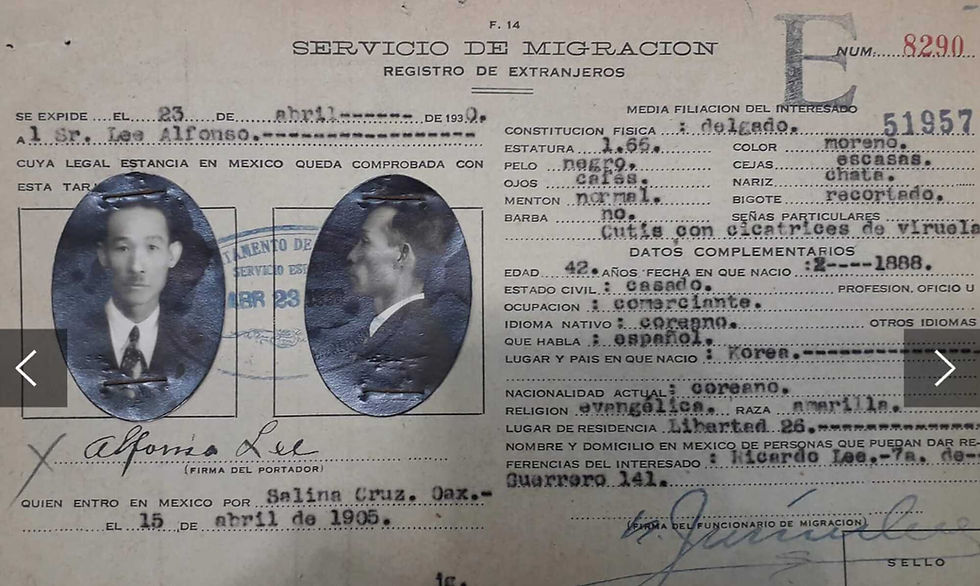
My Korean great-grandfather received a Mexican immigration cards in 1933. He had arrived in Mexico in 1905. What was he for the 28 years in between?
The Science of What We Carry
Today, we call this intergenerational trauma.Scientists studying the descendants of Holocaust survivors have found that trauma doesn’t just shape memory—it alters gene expression. Children and grandchildren inherit stress responses. Fear becomes physiology.
In Korea, we don’t need a lab to know this. We call it Han.
I call it a ghost.
It haunted my childhood. I saw it in my father’s hair-trigger grief. In my aunt María Chesun-Lee, now nearly 100, who still remembers the cruelty of the plantations—but rarely speaks of it.
Even as children, we knew something sacred and terrible lived just under the surface.
We asked questions we weren’t supposed to ask:“Auntie, why do you have those scars on your neck?”“Oh, it was a gum factory accident,” she’d reply. But we knew it wasn’t that simple.
What We Don’t Say
One thing that fuels intergenerational trauma is silence.Those who lived through horror don’t speak of it.Those who inherit it don’t know how to ask.
But I believe that remembering is a kind of healing.And writing is, too.
Maybe if we speak the names of our ghosts, they won’t haunt us so loudly.


Comments