My Ancestors Weren’t Lost — I Was. Uncovering the Forgotten History of Koreans in Mexico
The Paper Trail to My Past: How I Found My Korean Ancestors. How knowing who you come from teaches you a lot about who you are.
It’s early in the pandemic, when something that feels a lot like a whisper from the other world, comes to my sister through a phone call from the Korean Embassy. Probable scammer says: “Are you a relative of Lee Geon-se? He was known as Alfonso Lee in Mexico.”
My sister: “Hey, Mom, I think this is a scam call! They’re asking if we’re related to Alfonso Lee.”

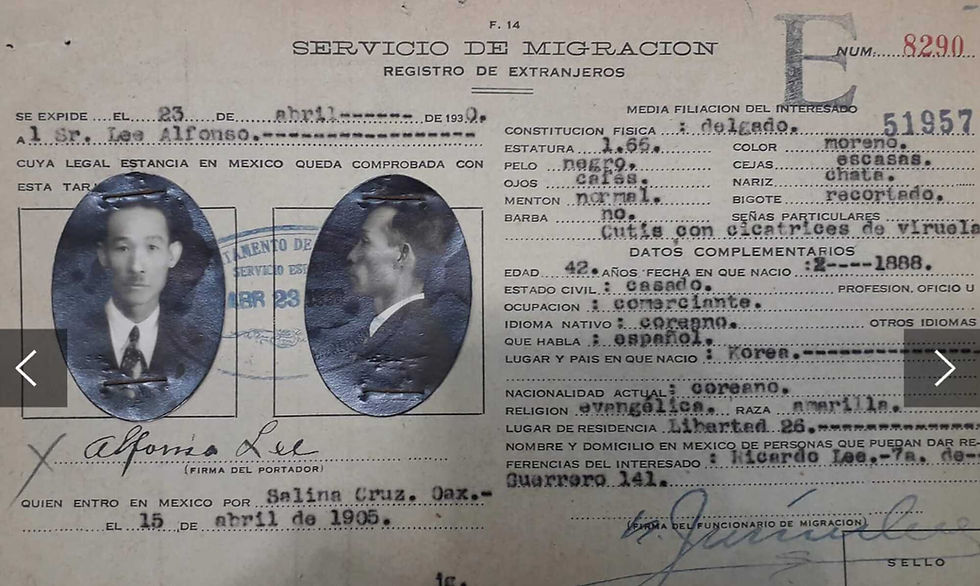
Mom: “No, wait, wait, he was your grandmother Lola’s father!”
My sister: “Um, yes? He was our great-grandfather, I think.”
Potential scammer: “Well, if you can prove you are his direct descendants, the eldest will receive a posthumous medal he is being awarded by the Ministry of Patriots in Korea.”
Immigrant families pass down silence, not happy stories. Traumatized people try to forget. Koreans don’t believe in “talking it out” or “sharing their feelings.” So I knew next to nothing about my family origins.
My first thought was: I wonder what a private detective costs?
No, that’s crazy! We’re in the middle of a pandemic, all I have is time! I can do this.
I have a friend in Korea. I tell him about the phone call and he’s ALL IN. He says he’s going to call the Ministry of Patriots and find out what’s going on.
I call the Korean Embassy in Mexico. They’re looking for my great-grandfather, Lee Geon-se’s direct descendants because he was awarded the National Foundation Medal for Independence Service Merit. This medal is given by the President of South Korea to individuals who made outstanding contributions to the establishment of the Republic of Korea.
The paperwork is bananas. I go into a step-by-step for the research in my free guide to finding your ancestors, but no one prepared me for the red tape. Phew! The red tape in Korea AND in Mexico! Embassies that insist on everything being notarized ($$$), people who ask, “And who did you say sent you here?”, “We will need certified copies of your birth certificate,” ($$) “Your documents are being sent in the diplomatic pouch and that only goes out once a week.”
What began as a quest to claim a medal turned into a deeper mission.
I found was that my family was sold into indentured servitude on the henequén plantations (a plant native to Yucatán, used to make rope).
It turns out the reason we were in Mexico was that in 1905, British and Japanese labor brokers recruited 1,033 Koreans with “contracts” to work on 32 haciendas. Twenty-two laborers were assigned to Hacienda Itzincab Cámara. At least 20 Koreans died within six months—children included—of disease and exhaustion.
A Journey of Intensity, Insanity, Insight, and Intuition
An Inheritance of Trauma.
The Stories We Were Never Meant to Know.
I started going back in my mind to things I had heard as a child, the immigrant silence I was met with when I asked my elders something about their past, the whispers in Korean between the elders. What had these people seen? What had they been through? Why were they trying to forget? WHAT did they want to forget?
I’m beginning to realize that I’ve been repeating patterns I never understood. Emotional flashbacks with no clear source. A simmering anger, a paralyzing silence, a longing for justice I couldn’t name. These weren’t wounds my parents inflicted—yet they live in me. Fear. Defensiveness. An ache I thought was personal but may actually be ancestral. Is this how trauma is passed down? Through blood, through silence, through behaviors inherited but never explained?
Then, a breakthrough. A contact in Yucatán sends me access to a shared drive—an online archive painstakingly compiled by members of the Korean-Mexican diaspora. Inside: scanned images of handwritten records from the early 1900s. Contracts. Immigration lists. Death registries. Yellowed with age, ink smudged by time. The script is so elegant it borders on illegible, but I press on.
As I begin to decipher them, a terrible clarity emerges.
These weren’t mere labor agreements. They were chains in ink. Stories of Koreans deceived, displaced, and dumped onto foreign soil to work in brutal, unfamiliar conditions. Names of children who didn’t survive the first season. Accounts of disease, starvation, and back-breaking labor in the henequén plantations of Yucatán—where the promise of opportunity turned into state-sanctioned exploitation. Racism wasn’t just cultural—it was economic, structural, deadly.
And as I read, something inside me clenches.
The nightmares I’ve carried weren’t just mine—they were echoes. The silence in my family wasn’t just cultural—it was survival. And the fire I feel now? It’s not rage without reason. It is history remembered in the body. A need for justice. For storytelling. For release.
Protected by Ghosts
After over a year of research in Mexico and Korea, I am now able to name my ancestors, the people who suffered so much before I existed. I can honor them for what they endured and that gives me solace. The least I can do is be strong and make them proud. The least I can do is some ancestral healing.
Tracing my Korean roots led me through history, heartbreak, and healing. It helped me understand not just where I come from, but why silence echoes so loudly in immigrant families.
And now, I no longer feel alone.
Where there was once silence, I feel presence. A quiet strength, as if the people I once thought were lost are now walking beside me. I say their names aloud and they feel real. I imagine them not as faded photos or forgotten records, but as a council of witnesses—watching, nodding, maybe even nudging me forward when I hesitate.
Their suffering wasn’t in vain. It echoes not as a weight, but as a rhythm I walk to. I feel accompanied now—by their resilience, their grit, their unspoken hopes passed down like invisible heirlooms.
I used to think I was searching for them. Maybe all along, they were waiting for me.
Ancestral healing isn’t just about the past. It’s about rewriting the narrative for the future—with their strength at my back.


Comments